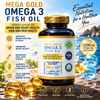
Mega Gold Omega 3-6-9 - What's Fish Oil?
, by Suprema Fuel Labs Ltd, 8 min reading time
, by Suprema Fuel Labs Ltd, 8 min reading time
When it comes to omega fatty acids, the number printed on the front of a bottle does not tell the whole story. A product may contain 2,000 mg of fish oil, but what really matters is how much of that oil comes from the key omega-3 fatty acids EPA and DHA.
Our Mega Gold Omega 3-6-9 provides a concentrated source of fish oil, delivering 2,000 mg of fish oil per serving, including 800 mg EPA and 600 mg DHA.
But what exactly are fish oil, EPA and DHA—and how are they different?
Fish oil is an oil obtained from oily fish and is naturally rich in long-chain omega-3 fatty acids.
The main omega-3 fatty acids found in fish oil are:
Fish oil can also contain other fatty acids, depending on the source and processing method.
One important distinction is that 2,000 mg of fish oil does not mean 2,000 mg of EPA and DHA.
For example, our formula provides:
| Nutrient | Amount |
|---|---|
| Fish Oil | 2,000 mg |
| EPA | 800 mg |
| DHA | 600 mg |
| EPA + DHA | 1,400 mg |
This means that a substantial proportion of the total fish oil is provided as the two principal long-chain omega-3 fatty acids.
Although EPA and DHA are both omega-3 fatty acids, they have different biological roles.
EPA is a long-chain omega-3 fatty acid involved in the production of signalling molecules that participate in normal inflammatory and cardiovascular processes.
EPA is particularly associated with:
EPA is also one of the omega-3 fatty acids commonly studied in relation to cardiovascular health.
DHA is another long-chain omega-3 fatty acid and is an important structural component of cell membranes.
DHA is particularly concentrated in tissues such as the:
DHA contributes to the maintenance of normal brain function and normal vision when the relevant dietary intake conditions are met.
EPA and DHA therefore should not simply be treated as interchangeable ingredients. They are closely related, but each has distinct physiological roles.
When comparing omega-3 supplements, consumers often look only at the total fish oil amount.
For example:
Product A: 2,000 mg fish oil
Product B: 1,000 mg fish oil
At first glance, Product A appears twice as strong.
However, the more useful comparison is often the amount of EPA + DHA supplied.
Our Mega Gold formula provides:
This gives customers a convenient way to obtain a concentrated amount of the two principal long-chain omega-3 fatty acids in a single formula.
Omega-3, omega-6 and omega-9 are all fatty acids, but they are not the same.
Includes EPA and DHA.
These are polyunsaturated fatty acids (PUFAs).
Omega-6 fatty acids are also polyunsaturated fats and are found naturally in foods such as nuts, seeds and vegetable oils.
Linoleic acid is an essential omega-6 fatty acid because the body cannot produce it in sufficient amounts and therefore needs to obtain it from the diet.
Omega-9 fatty acids, such as oleic acid, are monounsaturated fatty acids (MUFAs).
Unlike omega-3 and omega-6 essential fatty acids, omega-9 is not considered essential because the body can synthesise it.
Think of it this way:
Fish oil = the overall oil
EPA + DHA = two of the most important omega-3 components within that oil
So when selecting a fish oil supplement, it is useful to look beyond the headline number and check the actual EPA and DHA quantities.
Not all fish oil supplements provide the same concentration of EPA and DHA.
A lower-concentration product may require several capsules to provide a meaningful amount of EPA and DHA.
A concentrated formula can make it easier to obtain higher amounts without having to consume a large number of capsules.
2,000 mg fish oil
with:
800 mg EPA
600 mg DHA
1,400 mg combined EPA + DHA
That makes the formula particularly suitable for consumers who are specifically looking for a high-strength omega-3 supplement.
The terms capsule and softgel are sometimes used interchangeably, but they can describe different dosage-form technologies.
Traditional hard capsules generally consist of two pieces that fit together.
They are commonly used for:
Softgels are sealed, one-piece capsules with a soft, flexible outer shell.
They are particularly common for:
Because fish oil is an oil-based ingredient, softgels are a very common delivery format for omega-3 products.
Softgels provide a convenient way to encapsulate oils in a sealed dosage form.
For consumers, this means:
The choice between a hard capsule and softgel does not, by itself, determine whether an omega-3 product is effective. The formulation, ingredient quality, EPA/DHA concentration, serving size and manufacturing standards are more important considerations.
Mega Gold is designed around concentration rather than simply a large headline fish-oil number.
Each serving provides:
This makes the product particularly attractive to consumers who want to know exactly how much EPA and DHA they are getting.
Rather than focusing exclusively on the total oil content, the formula highlights the quantities of the two key long-chain omega-3 fatty acids.
Not exactly.
Fish oil is an oil that naturally contains omega-3 fatty acids, particularly EPA and DHA. Omega-3 is a broader category of polyunsaturated fatty acids.
No.
Both are long-chain omega-3 fatty acids, but they have different structures and physiological roles.
EPA = Eicosapentaenoic Acid
DHA = Docosahexaenoic Acid
The stated formula provides:
800 mg EPA + 600 mg DHA = 1,400 mg combined EPA and DHA.
No.
The fish oil quantity refers to the total amount of fish oil. EPA and DHA represent specific fatty acids contained within that oil.
This is why comparing EPA and DHA concentrations can be more informative than comparing total fish oil alone.
DHA is a structural omega-3 fatty acid found in particularly high concentrations in the brain and retina. DHA contributes to the maintenance of normal brain function and normal vision under the applicable authorised nutrition-claim conditions.
EPA is a long-chain omega-3 fatty acid involved in normal physiological signalling and is extensively studied for its role in cardiovascular health.
No. Unlike omega-3 and omega-6 essential fatty acids, the body can synthesise omega-9 fatty acids.
Not automatically.
Softgels are particularly well suited to oil-based ingredients such as fish oil, but the dosage form itself does not determine the overall quality of the supplement.
Look at the EPA and DHA content, ingredient quality, manufacturing standards and serving size when comparing products.
Look beyond the total fish oil number.
Compare:
For example, Mega Gold provides 2,000 mg fish oil with 1,400 mg combined EPA + DHA, making the EPA/DHA concentration immediately clear.
Omega-3 supplementation is not simply about finding the bottle with the biggest number.
Fish oil is the source. EPA and DHA are key omega-3 fatty acids within that oil.
With 2,000 mg of fish oil, 800 mg EPA and 600 mg DHA, Mega Gold is formulated to provide a concentrated supply of the two principal long-chain omega-3 fatty acids in a convenient softgel format.
2,000 mg Fish Oil.
800 mg EPA.
600 mg DHA.
1,400 mg combined EPA + DHA.
A straightforward, high-concentration omega-3 formula for consumers who want to know exactly what they are getting.