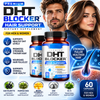
DHT and Hair Loss: The Science Behind DHT Blocker Hair Support
, by Suprema Fuel Labs Ltd, 9 min reading time
, by Suprema Fuel Labs Ltd, 9 min reading time
Hair thinning is a complex biological process involving genetics, hormones, follicle sensitivity, nutrition, ageing and other factors. One of the best-studied hormonal pathways in androgenetic alopecia (AGA)—also called pattern hair loss—is the interaction between dihydrotestosterone (DHT) and susceptible hair follicles.
Docteat DHT Blocker Hair Support is formulated with ingredients including saw palmetto, pumpkin seed and biotin, alongside other vitamins and nutrients, and is designed to support healthy hair growth and the appearance of stronger, fuller hair.
The important distinction is that a dietary supplement should not be presented as equivalent to prescription DHT-lowering medicines. The evidence for individual botanical ingredients is promising in some studies but substantially less established than the evidence for medicines such as finasteride. AAD
Dihydrotestosterone (DHT) is an androgen produced from testosterone. The conversion is carried out by an enzyme called 5-alpha-reductase (5α-reductase).
In genetically susceptible hair follicles, particularly in the frontal and vertex regions of the scalp, DHT binds to androgen receptors in follicular cells. This activates signalling pathways that progressively alter the normal hair-growth cycle. PubMed Central (PMC)
The important point is that DHT does not cause the same effect in every hair follicle. Genetic sensitivity to androgens is a major component of AGA. This explains why follicles on the scalp can progressively miniaturise while hair in other regions remains relatively unaffected. PubMed Central (PMC)

A healthy terminal hair follicle normally cycles through phases of growth, regression and rest. In AGA, prolonged androgen signalling changes this cycle.
DHT-related signalling can:
This process is gradual, which is why pattern hair loss often initially appears as increased scalp visibility, a widening parting, a receding hairline or thinning at the crown.
The pathway can be simplified as:
Testosterone → 5-alpha-reductase → DHT → Androgen receptor → Follicular signalling → Miniaturisation
This is why 5-alpha-reductase has become an important target in research and treatment of androgenetic alopecia.
Prescription finasteride, for example, reduces the conversion of testosterone into DHT by inhibiting 5-alpha-reductase. It has demonstrated efficacy for male pattern hair loss and is a medically regulated treatment rather than a dietary supplement. AAD
This distinction matters when discussing products described as "DHT blockers": reducing DHT production, reducing DHT signalling, and supporting the hair follicle are not the same biological action.
Saw palmetto (Serenoa repens) is one of the most widely studied botanical ingredients in natural hair-support formulations.
Its proposed mechanism is related to 5-alpha-reductase activity, potentially reducing conversion of testosterone to DHT. However, the degree to which oral saw palmetto produces clinically meaningful DHT reduction depends on the preparation, dose and individual response.
A systematic review of studies involving saw-palmetto-containing products found potentially beneficial effects on hair quality, hair count and density, but the researchers emphasised that the overall evidence remains limited and that larger, higher-quality trials are needed. PubMed
A more recent randomized, placebo-controlled study using a standardised saw palmetto oil reported reduced hair fall and increased hair density over 16 weeks, together with a reduction in serum DHT. However, the product studied was a specific standardized extract, so its findings cannot automatically be applied to every saw palmetto supplement. The study also included industry-employed investigators, which is another reason to interpret the results cautiously. PubMed

Saw palmetto may therefore be described as an ingredient with potential antiandrogenic and 5-alpha-reductase-related activity, rather than as a proven equivalent to a prescription DHT inhibitor.
Pumpkin seed preparations have attracted interest because they contain phytosterols and other bioactive compounds that may influence androgen-related pathways.
One randomized, double-blind, placebo-controlled study enrolled 76 men with mild-to-moderate androgenetic alopecia. Participants receiving 400 mg of pumpkin seed oil daily for 24 weeks experienced a greater increase in hair count than the placebo group. The study reported a mean hair-count increase of approximately 40% in the treatment group versus 10% in the placebo group. PubMed
The exact mechanism is not fully established. In laboratory and preclinical research, components of pumpkin seed oil have been associated with inhibition of 5-alpha-reductase, providing one possible explanation for the observed effects. PubMed
It is important to note that this clinical trial involved a specific pumpkin seed oil preparation and dose. It should not be interpreted as proof that every pumpkin seed supplement produces the same result.
Biotin, also known as vitamin B7, is frequently included in hair supplements.
Biotin participates in several metabolic reactions and is important for normal cellular function. Severe biotin deficiency can cause hair thinning or hair loss.
However, this does not mean that taking additional biotin automatically stimulates hair growth in people who already have adequate biotin status. The U.S. National Institutes of Health notes that there is currently little scientific evidence supporting routine biotin supplementation for hair, skin or nail health in people without deficiency. ODS
Therefore, biotin is better understood as a nutritional support ingredient, rather than a DHT blocker.
Your product description states "Biotin 2000mg." This amount should be verified against the manufacturer's original specification before publication.
Biotin is normally declared in micrograms (µg/mcg) or milligrams in much smaller quantities; 2,000 mg would equal 2 grams, which is an exceptionally large amount and is not a conventional biotin dosage. NIH data indicate that typical dietary intakes are measured in micrograms per day. High-dose biotin can also interfere with certain laboratory tests. ODS
For an e-commerce product page, I would verify whether the intended amount is 2,000 mcg (2 mg) rather than 2,000 mg.
This is where scientific accuracy is particularly important.
A product containing saw palmetto and pumpkin seed should not automatically be described as blocking all DHT in the body.
There are several different biological possibilities:
5-alpha-reductase inhibition
↓
Less testosterone converted into DHT
Reduced DHT exposure
↓
Potentially less androgen signalling in susceptible follicles
Androgen-receptor antagonism
↓
DHT has less ability to activate its receptor
These are distinct mechanisms.
Prescription DHT-lowering medicines have substantially more established evidence than botanical supplements. The American Academy of Dermatology identifies finasteride and minoxidil among established treatments for male pattern hair loss. AAD
For a supplement, the scientifically responsible language is therefore "supports healthy hair growth and provides ingredients studied for their relationship with androgen and DHT pathways", rather than claiming that the product definitively blocks DHT or treats hair loss.
For people with androgenetic alopecia, reducing androgen signalling can help slow the follicular miniaturisation process.
This is why DHT-related treatments can improve hair retention in appropriately diagnosed patients. However, hair follicles that have been significantly miniaturised for a long period may not immediately return to their previous size, and individual responses vary.
Hair growth is also slow. Even established treatments generally require months rather than weeks to demonstrate measurable changes. AAD
A recent systematic review and network meta-analysis of dietary supplements for AGA found that several supplements, including pumpkin seed oil and saw palmetto-containing preparations, showed positive signals for measures such as hair density. At the same time, the authors concluded that larger, higher-quality randomized trials are still needed. PubMed

Not all hair loss is androgenetic.
Hair shedding can also be associated with:
Consequently, someone experiencing sudden, severe or unexplained hair loss should not assume that DHT is the cause.
A dermatologist or other qualified healthcare professional can determine the underlying pattern and whether androgenetic alopecia is present.
The product is marketed for adult men and women.
However, the biology of hair loss is not identical between sexes. In women, pattern hair loss can occur with or without obvious androgen excess, and the causes can be multifactorial.
For this reason, a product formulated around the DHT pathway should not be presented as an explanation for every form of female hair thinning.
The rationale behind a formula containing saw palmetto, pumpkin seed and biotin is therefore different from that of a pharmaceutical treatment.
Potentially influences the androgen/DHT pathway through 5-alpha-reductase-related mechanisms. Clinical evidence is promising but not definitive. PubMed
Has clinical evidence from a small randomized trial showing increased hair counts in men with AGA; the precise mechanism remains under investigation. PubMed
Supports normal nutritional physiology, but additional supplementation has limited evidence for stimulating hair growth when deficiency is absent. ODS
Together, these ingredients provide a nutritional hair-support approach, rather than a pharmaceutical DHT-treatment protocol.
Product: DHT Blocker Hair Support
Format: Capsules
Pack size: 60 capsules
Suitable for: Adults
Main highlighted ingredients: Saw Palmetto, Pumpkin Seed and Biotin
Storage: Store at normal temperature in a cool, dry place
Shelf life: 2 years
DHT is an important biological factor in androgenetic alopecia. In genetically susceptible follicles, testosterone is converted into DHT by 5-alpha-reductase, and DHT can activate androgen receptors that progressively alter the hair-growth cycle and contribute to follicular miniaturisation. PubMed Central (PMC)
Ingredients such as saw palmetto and pumpkin seed have scientific rationale and some human clinical evidence for supporting hair density and reducing hair fall, but their effects should not be overstated. Biotin supports normal nutrition but is not, by itself, a proven DHT blocker. PubMed
The most accurate description of DHT Blocker Hair Support is therefore:
A nutritional hair-support formula containing botanicals and nutrients studied for their potential role in maintaining healthy hair and supporting pathways associated with androgen-related hair thinning.
Important: This product is a food supplement and is not intended to diagnose, treat, cure or prevent any disease. It should not replace professional assessment or evidence-based medical treatment for androgenetic alopecia or other causes of hair loss.
Because hair loss can have many causes, persistent, sudden or significant shedding should be evaluated by a healthcare professional.